
 info@markteffect.nl
  Back to the website

.jpg?modified=1628589087)
The Byron Sharp principle (FAST)
The Byron Sharp theory applies to product categories where the decision to make a purchase is made quickly. The Byron Sharp principle is therefore characterized by FAST.
The FAST method is based on the principle that consumers have no emotional attachment to brands and therefore do not base their choices on brand image or other rational aspects. According to Byron Sharp, consumers are guided solely by situations in which they think of a brand (category entry points), recognize brands by certain specific characteristics (distinctive brand assets), and by physical availability.
Image values play a less significant role in this principle. The better the mental and physical availability, the greater the penetration growth. Brands grow by attracting new buyers, not by making current buyers more loyal.
To stimulate brand penetration, a brand must stand out so that buyers can easily identify with it. Consumers often do not see why the brand they use is different from other brands on the market. They have knowledge about the brand they use, but not about brands they do not use. Marketers must ensure that their brand stands out from other brands.
Schematic representation of Byron Sharp's way of thinking
For Byron Sharp, a lot depends on the balance between mental availability and physical availability. Organizations that want to grow need to find the right balance between these two. This is illustrated in the image below.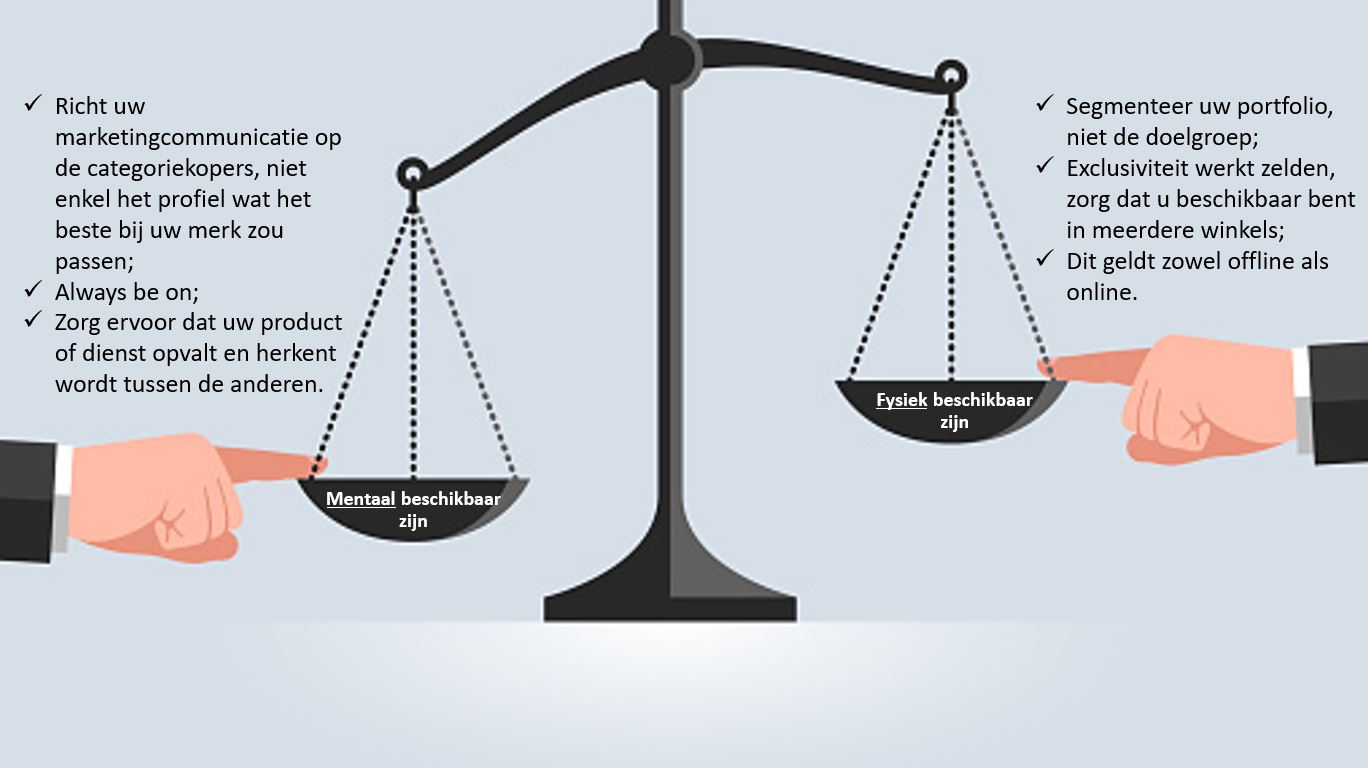
Byron Sharp's "always be on" is one of his most important ideas: it means that you need to be present when consumers need you. This is not possible for all brands, as it requires a significant investment in both physical and mental distribution. After all, broad distribution in stores is not easy to achieve, and high top-of-mind brand awareness is a long-term endeavour (and requires a substantial budget!).
That is why it is important for brands to also work on their distinctive brand assets: unique characteristics that consumers immediately recognize as belonging to your brand. These should be so clear that even if part of the message were to be removed, people would still immediately know which brand it refers to.