
FMCG shopping segmentation

As a brand, retailer, or manufacturer in the FMCG or food industry, you deal with shoppers and consumers. A shopper (the person who makes the purchase) may also be the consumer (the person who consumes the product), but in many cases, the shopper buys the product for another consumer, such as a member of their household. Good shopper segmentation helps to provide insight into the different types of shoppers, why people buy certain products, and why they do so at the retailer in question.

A shopper segmentation study provides insight into the following key question: "What are the actual market shares of my brands within the category at specific retailers based on shopping segmentation, and where are the greatest opportunities for my brand per retailer?"
The insights from this study help you develop a customized strategy per retailer and per product in order to stimulate rotation on the shop floor as effectively as possible.

We engaged Markteffect to evaluate our marketing strategy, a comprehensive assignment. Markteffect the gap between theory and practice for us by investigating the drivers and barriers of Jos Poell customers. The research was specifically tailored to our category and industry. However, the collaboration between Jos Poell and Markteffect beyond research; thanks to their objective and critical perspective, they were the ideal sparring partner.

Thank you for your dedication and valuable input. I found working with you to be extremely professional and enjoyable. We Markteffect recommend other companies to work with Markteffect !
Cyrille Berger - Marketing Manager, Jos Poell

Shopping segmentation

To gain insight into the various target groups and segments among the buyers of your product, Markteffect can perform shopper Markteffect . Specifically, this provides insight into who your most important target groups are and what their drivers and barriers are for buying your products or, conversely, not buying them. It also focuses explicitly on the choice of retailer, for example, why someone buys your product at Jumbo and not at Albert Heijn.

Ensuring that your product is listed and widely distributed among various retailers is a costly and time-consuming process. Once your product is readily available to consumers, it is essential that it rotates quickly. Otherwise, there is a real chance that the product will disappear from the shelves again in the foreseeable future.

The shopper segmentation study helps you answer a number of important questions. Among other things, you will receive answers to:

  • Who is my shopper and what are their key characteristics?
  • What are the reasons for buying or not buying my product?
  • What is the penetration and volume of my category and my brand?
  • During which shopping trip is my product mainly purchased?
  • What differences are there in purchasing behavior or shopping trips per retailer?
  • What else is in the shopping basket besides my product?
  • Where are the growth opportunities for my category and product, per retailer?

Advice per retailer

The ultimate goal of shopper segmentation research is to help you provide substantiated advice to each retailer. To this end, Markteffect uses Markteffect Category Attraction Model, which compares the position of the category at a specific retailer against the national attraction value. Below is an example from Albert Heijn.
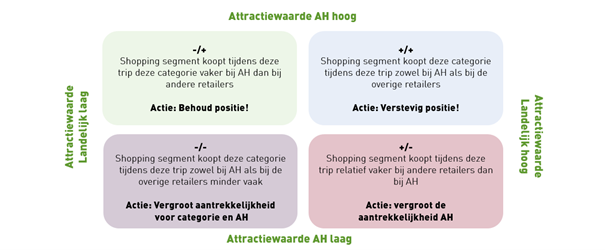
Based on extensive, representative, and validated research, we can determine which retail category your product falls into, enabling you to consistently provide sound advice on how to improve the rotation of your product and category.

target group 1

Understanding the types of shoppers in your category and brand

drivers-barriers

Understanding the drivers and barriers to purchasing your product

laptop-money-analytics

Input for strategic advice per retailer

Collaboration with the International Shopper Marketing Institute (ISMI)

Markteffect and validated the shopper segmentation research in collaboration with ISMI. Both parties have been working closely together for many years. The shopper segmentation was part of the Purchasing Behavior Monitor that both parties had previously developed.

Shopper marketing is about differentiating value propositions according to shopper characteristics and type of shopping trips (such as daily shopping, bulk shopping, and promotional shopping). This is market segmentation based on the factors that determine category and store choice. Traditional segmentation based solely on socio-demographic or psychographic factors explains consumer behavior but not shopper behavior.

Consumers belonging to the same market segment can exhibit very different purchasing behavior. The Purchasing Behavior Monitor provides more insight into store/channel choice in relation to the usage situation or purchase motivation."
Bram Nauta, ISMI

Shopper segmentation is a tool that not only maps the position of a category and brand within a specific retailer based on purchasing behavior and shopping segmentation, but also reveals the underlying purchase motivations. The reason for its development is the lack of an analysis tool on the market that answers the what (what, how much, and how often people buy something) and why questions on a continuous basis from a shopper marketing perspective. What makes it unique is that it maps not only supermarkets and drugstores, but also low-end retailers.

Similar cases

To give you a good idea of how market research works in practice and what it can do for you, we've put together a few cool case studies. You might recognize some of the issues, because you've probably come across them in your own organization.

Target group research forOnly for Men

Brand awareness and target group research:
Boels Rental

Customer satisfaction survey: Nettorama

Market exploration forVeerse Meer Water Park

<p>Patrick <span>Evers</span></p>

Patrick Evers

Client Consultant